
The wrong compaction method can lead to project delays, failed inspections and costly callbacks. We’ve created this guide to prevent that. Here, you’ll learn how to instantly match your material to the different types of compaction equipment for a stable, long-lasting result.
Selecting the ideal compactor involves identifying the soils you work with and the constraints of your jobsite. Let’s explore some of the most common materials and projects.
A vibratory compactor is ideal for granular soils like sand and gravel. Within this category, you can choose from vibratory plate compactors for smaller areas and smooth drum rollers for larger jobs.
Vibrations shake sand and gravel particles, resettling and locking them together for more stable compaction.
Cohesive soils like clay and silt resist vibration, which makes them harder to compact with standard smooth-drum or vibrating equipment. Breaking the bonds between these sticky particles requires high-impact force rather than pure vibration. Rammers and padfoot rollers excel in these situations. Rammers deliver concentrated, vertical impact, while padfoot rollers use a kneading action that works the soil from the surface down.
This approach also prevents a typical problem with cohesive soils — compacting only the top layer while the material underneath stays loose. Because rammers and padfoot rollers penetrate and work the deeper lifts, they prevent future settlement issues.
Use rammers when you need maneuverability in tight spaces or trenches. Choose padfoot rollers for expansive earthwork projects where you need to cover more ground efficiently.
When working with asphalt, you will need a combination of rollers for the breakdown, intermediate and finishing passes. Hot mix asphalt won’t wait for you. Temperature drops fast, so you need the correct compactor for each pass to get the density and smoothness right in a short window.
Start with a vibratory roller behind your paver, then make a pass with a pneumatic roller. Finish the surface with a smooth drum roller to ensure your roads meet the density and smoothness specs to pass inspection.
Rammers and walk-behind plate compactors provide the control you need in tight work areas like trenches, foundation edges and backfill zones. These hand-operated tools give you the precision to work around pipes, conduits and other utilities.
Rammers and plate compactors press the soil directly under their plates without putting lateral pressure on adjacent walls and other structures.
Now that you’ve identified the right category of machine for your job, here is a more detailed look at the specific types of compactors so you can decide between a plate compactor versus a rammer or whether you need more power.
A rammer, jumping jack or tamping rammer is a walk-behind compaction machine. Its vertical up-and-down motion is ideal for cohesive soils in tight spaces. The engine powers a piston and plate that punches down, squeezing water and air out of the soil.
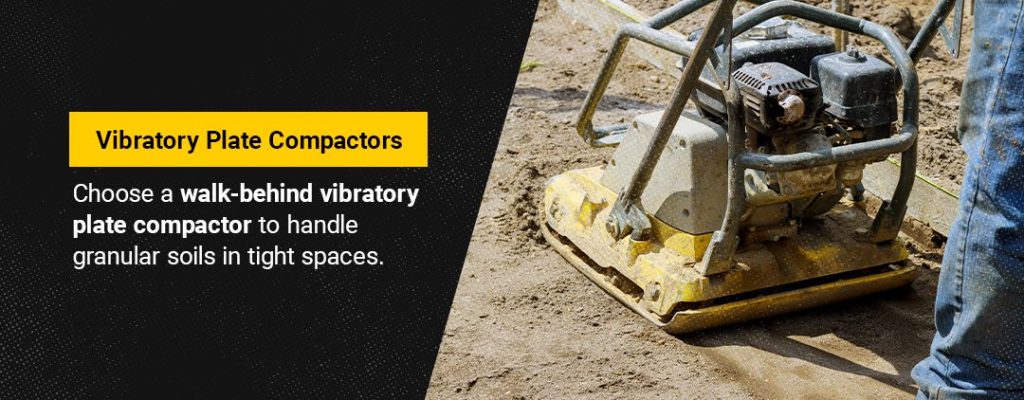
Choose a walk-behind vibratory plate compactor to handle granular soils in tight spaces. The vibrations it generates shake and settle soils to create stable foundations for patios, sidewalks and driveways.
Forward and reversible vibratory plates offer different advantages depending on the job.
You can also select vibratory plate compactor attachments for heavy equipment like excavators and backhoe loaders. These deliver additional force over a larger surface area than standard walk-behind plate compactors. If you already have access to an excavator or backhoe, using an attachment eliminates the need for a separate, dedicated roller for smaller, difficult-to-access areas.
You will need a roller for large-scale projects. There are various types of roller compactors to choose from, each suited to different soils and project types.
After you narrow down the type of compactor, consider the following factors to ensure your choice is the best for the job.
When comparing compactors, more force isn’t always better. A machine that is too heavy for the lift thickness can leave the base improperly compacted or even damage the material. On the flip side, if your soil is not compacted enough, settlement can occur, leading to callbacks. Check the manufacturer’s specs for the recommended lift height for each machine to ensure it matches your needs.
Often, it will be immediately obvious when you need the weight of a roller or the dexterity of a smaller rammer. But for some in-between jobs, you’ll need to compare the efficiency gains of choosing a compactor.
A reversible plate can handle a foundation pad, you’ll need the efficiency of a ride-on roller to maximize your margins for a large parking lot.
The dealer where you buy or rent your compactors matters as much as your machine selection. Choosing a local partner for your compactors has multiple benefits.
Choosing a quality compactor is only part of the decision. You also need a reliable partner to provide the expertise, service and support your project depends on.
As an authorized Cat® dealer, Gregory Poole offers a full range of new, used and rental compactors. When you partner with us, you gain access to over 75 years of regional experience and get fantastic post-sale product support when you need it. Browse our wide range of compaction equipment, or contact your local Gregory Poole representative today to get an expert recommendation for your next project.