
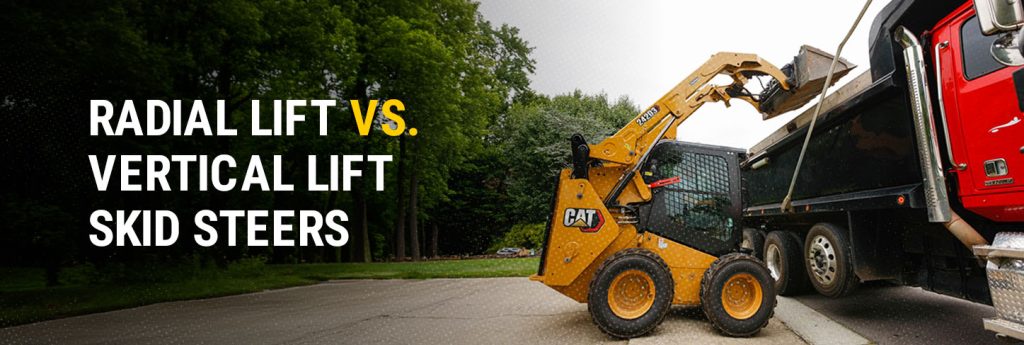
Choosing the right skid steer loader is one of the most important decisions you’ll make for your operation. Whether you’re a contractor, landscaper or fleet manager, these versatile pieces of equipment are essential. Understanding a radial lift vs. a vertical lift skid steer matters.
The right choice can help maximize ROI and productivity on every job. This guide breaks down both options so you can pick the machine that works best for your operation from day one.
The difference between radial lift and vertical lift skid steers comes down to how the lift arms move. One follows a simple arc, while the other lifts nearly straight up. Understanding these differences will help you match the equipment to the work you do most.
A radial lift uses a single-pivot design that swings the bucket in an arc as it lifts. Think of it like your arm reaching forward and up. You get maximum extension at mid-height, right around eye level or truck-bed height. This makes radial lift skid steer loaders ideal for tasks that require pushing, digging or loading at midrange.
The simpler design also means fewer moving parts and fewer grease points to maintain. For operators focused on digging footings, backfilling or grading, a radial lift delivers the power and extension where you need it most.
A vertical lift has more pivot points. Instead of swinging out in an arc, the arms lift almost straight up, keeping the load closer throughout the cycle. This design can move the load about 2 feet away and reach around 128 inches at maximum height, making it the better choice for high-elevation work.
If you’re stacking pallets, loading high-sided dump trucks or working with compact track loaders for maximum capacity, the vertical lift design keeps the center of gravity closer to the equipment for safer operation when loads are elevated.
Here’s how radial lift and vertical lift skid steers stack up across the factors that matter most for your buying decision:
| Feature | Radial Lift | Vertical Lift |
|---|---|---|
| Best for | Ground-level work, including digging, grading, backfilling, trenching and land clearing where forward reach matters most | High-reach applications, including loading tall trucks, stacking pallets, overhead dumping and any job requiring maximum lift height |
| Reach | Superior forward reach at eye level to the truck bed; the arc motion extends the bucket farther from the machine at midrange | Superior reach at full extension; keeps the load closer to the machine while lifting to maximum height for better control |
| Stability | Excellent stability for digging and pushing forces; the arc motion naturally distributes weight for ground-level tasks | Excellent stability when lifting heavy loads to full height; vertical path keeps the center of gravity closer to the machine |
| Mechanical system | Single-pivot design with simpler linkage and fewer moving parts; easier to service and maintain | Multi-pivot design with a more complex linkage system; additional pivot points provide the vertical lift motion |
| Cost | Lower up-front cost due to simpler design; fewer grease points and moving parts may reduce long-term maintenance expenses | Higher up-front cost due to more complex linkage; additional pivot points need more frequent greasing and maintenance |
| Visibility | Generally better visibility over the lift arms due to simpler, more open design; easier to see the bucket and work area | More complex linkage can create additional blind spots; operators may need to adjust positioning for optimal visibility |
Both options can handle serious work, but your rated operating capacity (ROC) will determine how much weight you can safely lift. You don’t need to calculate this — your equipment’s user manual provides the ROC for your model. The lift path determines where that capacity works best.
The right radial lift vs. vertical lift skid steer choice comes down to the jobs you run most often. Both types are available to rent or buy, new and used, giving you flexibility to match your budget and project timeline.
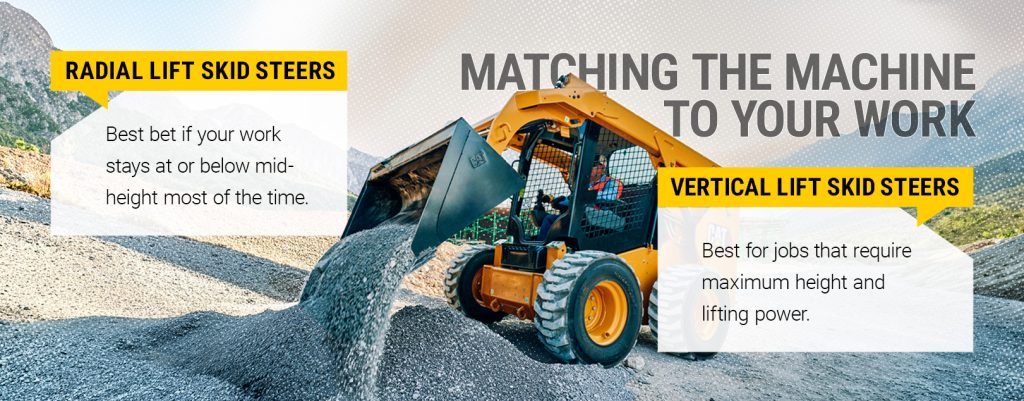
Radial lift skid steers are your best bet if your work stays at or below mid-height most of the time:
Vertical lift skid steers are best for jobs that require maximum height and lifting power. Vertical lift is the clear winner for these reasons:
Radial and vertical lift skid steers can run a wide range of work tools, from buckets and forks to augers and mulchers. The difference is efficiency. A vertical lift is better for forks, grapples and any attachment where you need to raise loads high and keep them secure. A radial lift excels with attachments like mulchers, trenchers and grading buckets that work best with forward extension and digging power at lower elevations.
Choosing between a radial lift vs. a vertical lift skid steer can be a big investment. You need a partner who gets your operation and knows the equipment inside and out. With more than 70 years in the business, Gregory Poole Equipment Company has the experience to help you pick the right option.
Our sales and product support teams will answer your questions, walk your site and point you to the skid steer that delivers. Ready to buy or rent, or looking for some straight advice? You can find your nearest sales rep or contact our team to get started.