

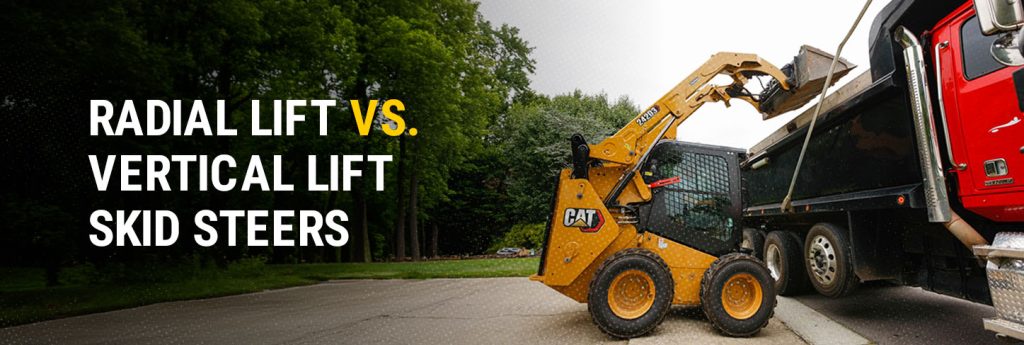
Elegir la minicargadora adecuada es una de las decisiones más importantes que tomarás para tu negocio. Tanto si eres contratista, paisajista o gestor de flotas, estos equipos tan versátiles son imprescindibles. Es importante comprender la diferencia entre una minicargadora de elevación radial y una de elevación vertical.
La elección adecuada puede ayudarte a maximizar el retorno de la inversión y la productividad en cada trabajo. Esta guía analiza ambas opciones para que puedas elegir la máquina que mejor se adapte a tu actividad desde el primer día.
La diferencia entre las minicargadoras de elevación radial y las de elevación vertical radica en el movimiento de los brazos de elevación. Unas describen un arco sencillo, mientras que las otras elevan la carga casi en línea recta. Comprender estas diferencias te ayudará a elegir el equipo más adecuado para el trabajo que realizas con mayor frecuencia.
Una elevación radial utiliza un diseño de pivote único que hace que la cuchara se mueva describiendo un arco a medida que se eleva. Imagínatelo como si extendieras el brazo hacia delante y hacia arriba. La extensión máxima se alcanza a media altura, justo a la altura de los ojos o a la altura de la plataforma de un camión. Esto hace quelas minicargadoras de elevaciónradial sean ideales para tareas que requieran empujar, excavar o cargar a media altura.
Este diseño más sencillo también se traduce en un menor número de piezas móviles y de puntos de engrase que requieren mantenimiento. Para los operadores que se dedican a excavar cimientos, rellenar zanjas o nivelar terrenos, una pala con elevación radial proporciona la potencia y el alcance allí donde más se necesitan.
Una grúa de elevación vertical cuenta con más puntos de pivote. En lugar de girar describiendo un arco, los brazos se elevan casi en línea recta, lo que mantiene la carga más cerca durante todo el ciclo. Este diseño permite desplazar la carga unos 2 pies yalcanzar unas 128 pulgadasde altura máxima, lo que la convierte en la mejor opción para trabajos a gran altura.
Tanto si apilas palés, como si cargas camiones volquete de paredes altas o trabajas concargadoras compactas sobre orugaspara aprovechar al máximo su capacidad, el diseño de elevación vertical mantiene el centro de gravedad más cerca del equipo, lo que garantiza un funcionamiento más seguro cuando se elevan las cargas.
A continuación te mostramos cómo se comparan las minicargadoras de elevación radial y de elevación vertical en función de los factores más importantes a la hora de tomar una decisión de compra:
| Artículo de fondo | Elevación radial | Elevación vertical |
|---|---|---|
| Ideal para | Trabajos a nivel del suelo, como excavación, nivelación, relleno, apertura de zanjas y desbroce, en los que el alcance hacia delante es fundamental | Aplicaciones que requieren un gran alcance, como la carga de camiones altos, el apilado de palés, el vaciado en altura y cualquier tarea que exija la máxima altura de elevación |
| Alcance | Alcance frontal superior a la altura de los ojos hasta la caja de la furgoneta; el movimiento en arco aleja aún más el cucharón de la máquina en el rango medio | Mayor alcance en extensión máxima; mantiene la carga más cerca de la máquina mientras se eleva hasta la altura máxima, lo que permite un mejor control |
| Estabilidad | Excelente estabilidad frente a las fuerzas de excavación y empuje; el movimiento en arco distribuye de forma natural el peso en las tareas a nivel del suelo | Excelente estabilidad al elevar cargas pesadas hasta la altura máxima; el recorrido vertical mantiene el centro de gravedad más cerca de la máquina |
| Sistema mecánico | Diseño de pivote único con un sistema de articulación más sencillo y menos piezas móviles; más fácil de reparar y mantener | Diseño multipivote con un sistema de articulaciones más complejo; los puntos de pivote adicionales permiten el movimiento de elevación vertical |
| Coste | Menor coste inicial gracias a un diseño más sencillo; el menor número de puntos de engrase y de piezas móviles puede reducir los gastos de mantenimiento a largo plazo | Mayor coste inicial debido a una articulación más compleja; los puntos de pivote adicionales requieren un engrase y un mantenimiento más frecuentes |
| Visibilidad | En general, ofrece una mejor visibilidad por encima de los brazos de elevación gracias a un diseño más sencillo y abierto; resulta más fácil ver la cuchara y la zona de trabajo | Un sistema de acoplamiento más complejo puede generar puntos ciegos adicionales; es posible que los operadores tengan que ajustar la posición para conseguir una visibilidad óptima. |
Ambas opciones son aptas para trabajos exigentes, pero tucapacidad nominal de funcionamiento (ROC)determinará cuánto peso puedes levantar con seguridad. No es necesario que lo calcules: el manual de usuario de tu equipo indica la ROC correspondiente a tu modelo. La trayectoria de elevación determina en qué situaciones se aprovecha mejor esa capacidad.
La elección entre una minicargadora con elevación radial derecha y una con elevación vertical depende de los trabajos que realices con mayor frecuencia. Ambos tipos están disponibles paraalquilar o comprar, tanto nuevos como de segunda mano, lo que te ofrece flexibilidad para adaptarte a tu presupuesto y a los plazos de tu proyecto.
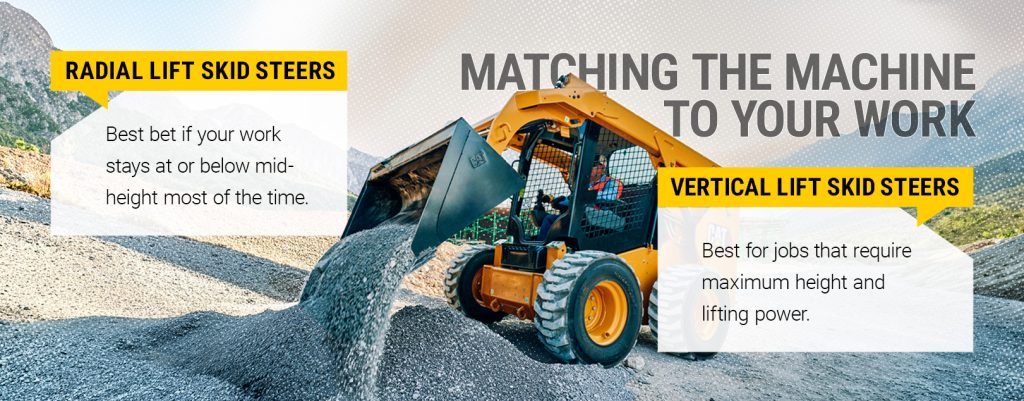
Las minicargadoras de elevación radialson tu mejor opción si tu trabajo se realiza, en su mayor parte, a una altura media o inferior:
Las minicargadoras de elevación verticalson las más adecuadas para trabajos que requieren la máxima altura y potencia de elevación. La elevación vertical es la opción más adecuada por las siguientes razones:
Las minicargadoras de elevación radial y vertical pueden utilizaruna amplia gama de implementos, desde cucharas y horquillas hasta barrenas y trituradoras. La diferencia radica en la eficiencia. La elevación vertical es más adecuada para horquillas, pinzas y cualquier implemento en el que sea necesario elevar cargas a gran altura y mantenerlas bien sujetas. La elevación radial destaca con implementos como trituradoras, zanjadoras y cucharas niveladoras, que funcionan mejor con extensión hacia delante y potencia de excavación a alturas más bajas.
Elegir entre una minicargadora de elevación radial y una de elevación vertical puede suponer una inversión importante. Necesitas un socio que comprenda tu negocio y conozca la maquinaria al dedillo. Con más de 70 años en el sector, Gregory Poole Equipment Company cuenta con la experiencia necesaria para ayudarte a elegir la opción más adecuada.
Nuestros equipos de ventas y de asistencia técnica responderán a tus preguntas, recorrerán tu emplazamiento y te recomendarán la minicargadora que mejor se adapte a tus necesidades. ¿Estás listo para comprar o alquilar, o simplemente buscas un consejo sincero? Puedesencontrar a tu representante de ventas más cercanooponerte en contacto con nuestro equipopara dar los primeros pasos.