


You need accurate production data to control costs and output on every project. Measuring dozer productivity begins with a defined formula. Calculate bank cubic yards per pass, multiply by cycles per hour, then adjust for material density, slope and operator delay.
The calculation provides a realistic hourly production rate, allowing for a direct comparison with planned quantities and fuel consumption to isolate performance gaps.
When production declines, review blade load factor, push distance and gear selection. Accurate measurements strengthen estimating and crew planning by providing verified rates that support tighter cost projections.
Review cycle data to confirm that operators maintain full blade loads and apply slot dozing when material conditions allow. GPS data, telematics reports and grade control feedback provide continuous insight, helping crews adjust travel patterns and reduce lost time.
Dozer productivity defines the volume of material moved per unit of time, expressed in loose cubic yards per hour or loose cubic meters per hour (LCM). The metric explains how to measure dozer efficiency by focusing on production rate rather than the total operating cost. Unit cost includes fuel and labor inputs, while productivity isolates material movement over time.
A productive dozer reduces cycle time and maximizes time spent pushing material. Blade load efficiency, push distance and operator technique directly influence output. Terrain can affect performance, with downhill pushes increasing production and uphill travel reducing output. Slot dozing can increase blade capacity by up to 20% under suitable ground conditions.
BCY represents material in natural ground conditions and serves as the standard unit for quantity takeoffs and contract payments. LCY describes soil after excavation, when expansion increases volume. Compacted cubic yards (CCY) measure material after placement and mechanical compaction.
Accurate unit conversion supports any dozer productivity formula, as production estimates must match contract quantities. Consider the following example. A cut of 100 BCY of clay with a 25% swell factor expands to 125 LCY once excavated. Apply a load factor of 1 divided by 1.25 to convert 125 LCY back to 100 BCY for consistent reporting.
You can use the following definitions when calculating production:
Production variables convert theoretical blade capacity into realistic output by accounting for time, volume and field conditions. Cycle time defines the total duration required to push and return per pass.
Blade capacity reflects the rated heaped or struck volume, while blade load refers to the actual material moved in one cycle after applying the fill factor. A blade fill factor adjusts the rated volume to reflect spillage under load.
Efficiency applies a field correction for operator performance and terrain resistance — for example, a 0.83 efficiency factor with 50 minutes of productive time per hour.
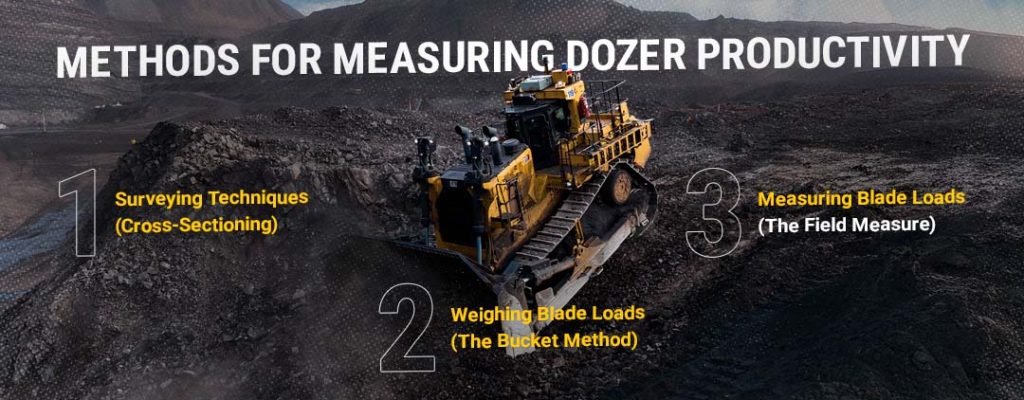
Measurement methods translate observed dozer work into realistic production rates expressed in LCY per hour or LCM per hour. Each approach reviews cycle counts and material volume. The goal is consistent alignment between field performance and calculated output.
Surveying techniques measure total volume change across a cut or fill area to calculate production over a defined period. Cross-sectioning works well when isolating individual passes proves to be impractical. The method compares existing ground to design surfaces, producing defensible quantities directly associated with project plans.
Apply cross-sectioning with defined field controls:
The weight-to-volume method verifies dozer output by weighing stockpiles created by the dozer and converting scaled tons into loose cubic yards.
A dozer cannot be weighed during a push, so a loader and certified scale act as the verification tools. By loading dozer-built piles into haul trucks and recording payload weights, crews can calculate material density and determine average volume per blade pass.
Field measurement estimates LCY per pass using basic tools and direct observation. The method requires a tape measure and a level area to shape and measure dozer piles.
Crews record pile dimensions, calculate approximate volume and average several samples to reduce variation between heavy and light pushes. After establishing LCY per pass, supervisors multiply by the number of cycles per hour to project LCY per hour.
Measuring dozer productivity starts with blade load. Multiply the average LCY per pass by cycles per hour and apply swell or load factors when converting to BCY for contract reporting.
Cycle time measures the duration required to complete one push and return sequence.
Use a stopwatch to time at least five full cycles from blade engagement to blade reentry. Then, divide the total seconds by the number of cycles to find the average.
Divide the result by 60 to convert seconds into decimal minutes, since most production tables and performance software calculate output using decimal-minute inputs.
Determine unadjusted production by multiplying LCY per pass by cycles per hour. Perform this calculation before converting to bank measure or applying cost factors.
The resulting LCY per hour represents raw production and serves as a consistent baseline when comparing different dozer sizes or blade configurations.
Apply a load factor to convert LCY per hour to BCY per hour when material expands after excavation. Use one consistent load factor for each material type in the estimate so the reported quantities remain traceable.
Clearly document the calculation, since BCY per hour will be lower than LCY per hour for swelled material and directly affects contract reporting and production commitments.
Apply the overall efficiency factor to the bank production rate so the difference between the ideal and expected outputs remains visible. The calculation shows how delays, operator breaks and site constraints affect the final output.
Use conservative efficiency factors when preparing bids to reduce financial risk. Internal planning may justify slightly higher factors when setting performance targets under controlled conditions.
Cat® technology automates production tracking so you spend less time estimating and more time validating performance data. Integrated systems make it easy to learn how to measure dozer efficiency by capturing blade loads, cycle counts and operator inputs across the fleet in near real time.
Cat Grade with 3D automatically controls blade elevation and slope, eliminating the need to chase grade stakes across the site. Using global navigation satellite system (GNSS) data, the system adjusts blade lift and tilt to match the digital design in real time, while the operator controls travel and steering.
The platform reduces overcutting and limits rework, which increases useful BCY per hour even when raw LCY per hour remains similar. Automated blade guidance keeps production aligned with plan surfaces across operators and shifts.
VisionLink Productivity consolidates machine data into a single dashboard so managers can identify which dozers are producing and which units spend excessive time idling. The platform highlights patterns like extended idle periods or dump-area bottlenecks that reduce effective output.
Production reports also support after-action reviews by comparing planned production curves with actual volume moved, allowing teams to refine assumptions and improve future estimates.

Measurement errors often result from selective cycle timing, inconsistent unit reporting and unrealistic production targets. Timing only the peak cycles inflates averages, and confusing LCY with BCY creates gains on paper that don’t exist in reality. Pressure to meet theoretical 60-minute targets can also distort weight-to-volume data and reduce attention to routine maintenance.
Gregory Poole Equipment Company provides guidance on equipment and technology solutions aligned with your operational and production requirements. Our team delivers ongoing support through equipment management services and Customer Value Agreements tailored to your fleet.
Contact us to evaluate your dozer fleet and implement accurate production measurement systems.