

Choosing the right excavator configuration is about more than knowing the right horsepower or bucket size — it’s about matching the machine’s swing radius to your work environment. Zero tail swing and conventional excavators handle rotation differently. Matching the right design to your jobsite conditions ensures smooth operation near structures and maximizes productivity on open terrain.
Whether you’re working in tight residential corridors or managing high-volume earthmoving on open sites, understanding how each configuration performs will help you choose the right one for your operation. At Gregory Poole, we help contractors and fleet managers across eastern North Carolina match the right Cat® machine to the work at hand.
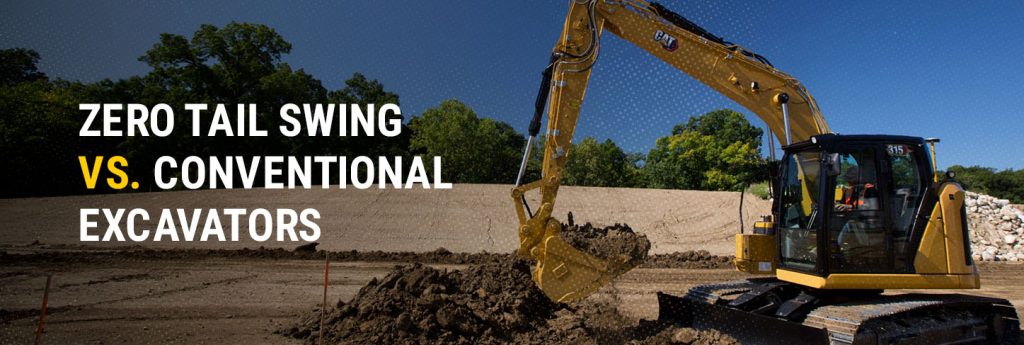
Zero tail swing and conventional excavators differ in counterweight position and how far the upper housing extends beyond the tracks during rotation.
Zero tail swing machines are designed so the upper body rotates within or at the width of the tracks, keeping the counterweight inside the track footprint throughout the entire swing cycle. Conventional excavators use a larger counterweight that swings out significantly beyond the tracks when the upper house rotates.
Zero tail swing excavators are the right choice when space is tight and swing clearance impacts your efficiency.
Confined spaces like fenced residential backyards and narrow alleyways are great use cases for zero tail swing excavators. These spaces all have limited clearance on at least one side of the machine, so your excavator must rotate without the counterweight hitting nearby obstructions.
A zero tail swing excavator can make these jobs much more manageable, as you can position the machine tight against a fence line or property boundary and still swing the boom through a full rotation without repositioning. If you’re excavating along a roadway or performing utility work in a traffic zone, this type of excavator is also safer, since it won’t swing into adjacent lanes or near passing vehicles.
A zero tail swing excavator can help you avoid contact with buildings, retaining walls, fences, traffic barriers or buried utility markers. The excavator’s minimized counterweight radius means it’s less likely to damage property when working close to buildings and other obstructions. Beyond benefiting your productivity, this capability can also help avoid safety incidents or damage claims.
If you frequently work within a few feet of structures, parked vehicles or active utilities, a compact radius mini excavator gives you the clearance confidence you need to operate without constant repositioning or risk management.
Conventional tail swing machines are the better fit when you’re working in open sites or need to lift heavier loads.
Large open construction sites, land clearing projects, loading trucks in quarries and agricultural grading all benefit from conventional excavators. If you’re working on a site where the machine’s sole purpose is loading trucks and moving dirt, a conventional excavator gives you greater flexibility in strength and operation. When the jobsite gives you room to swing freely, you can push the machine harder without worrying about clearance on every rotation.
Conventional models are also great for heavy lifting, digging on slopes or working on uneven terrain where you need stability. The counterweight’s extended position behind the tracks creates additional leverage, becoming an asset rather than a liability when you’re not hemmed in by obstacles.
A conventional machine’s counterweight extends farther behind the tracks, giving you more leverage and counterbalance for heavy lifts and steep-grade operation. Conventional tail swing excavators can have a larger maximum dig depth and longer reach for lifting heavy loads or digging with a larger bucket. Zero tail swing machines trade some of that counterweight mass and position for compactness, which can reduce maximum lifting capacity and affect stability on grades.
If your work regularly involves lifting heavy materials, operating on slopes or digging at maximum depth, the conventional configuration gives you the counterweight advantage you need to handle those demanding conditions safely.
When you’re comparing zero tail swing and conventional excavators, consider these performance differences to choose the right configuration for your job:
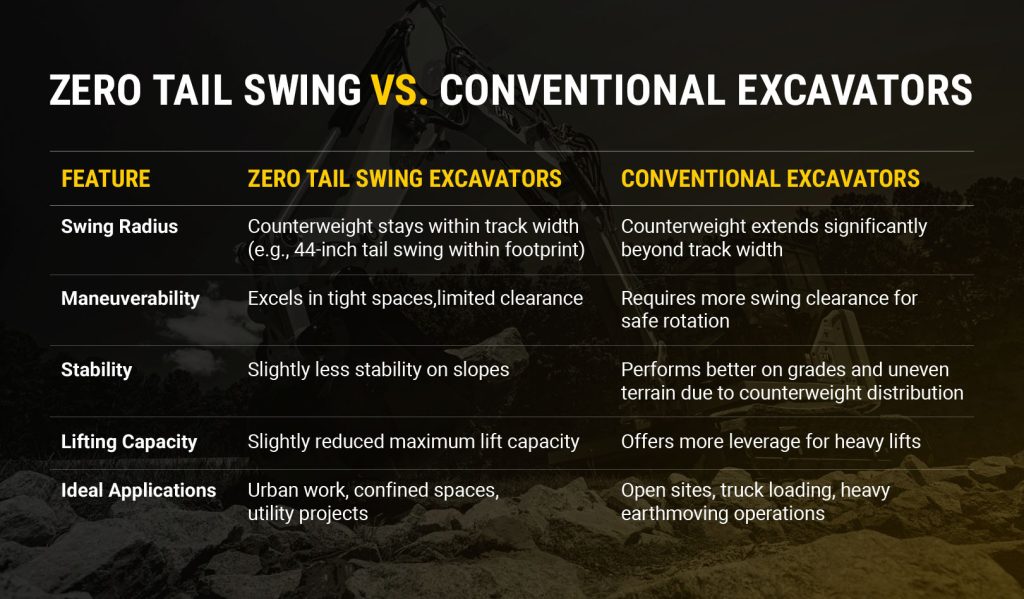
Understanding these trade-offs helps you match machine configuration to the work you’re actually doing. For more context on how excavator configurations affect performance across different applications, our equipment guide provides additional detail.
The right excavator configuration depends on your work environment and job demands. If you’re operating near structures, traffic or property lines where swing clearance is limited, zero tail swing is the right choice. If you’re working on slopes, lifting heavy materials or digging at maximum depth regularly, conventional machines give you a counterweight advantage for more stability and leverage. When you move between both confined and open-site conditions, choose an excavator that matches the working environment you’re most frequently in.
The Cat CR (Compact Radius) lineup at Gregory Poole is built specifically for operators who need zero or reduced tail swing performance without sacrificing the reliability and build quality of Cat equipment. The Cat 308 CR, for example, delivers compact radius performance in a proven mini excavator platform. It handles both confined work and general excavation with equal capability.