

Buying used Cat® equipment is a budget-friendly choice when reliability and cost control are equal priorities. However, avoiding unexpected equipment failures requires additional decisions and considerations. While a machine may look work‑ready during a quick visual inspection, long‑term performance often depends on factors that aren’t immediately noticeable.
Unplanned downtime has significant ripple effects when construction schedules are tight or seasonal demand spikes. Crews sit idle, rental costs climb and project timelines slip off track during the busiest periods across Eastern North Carolina. Those disruptions can quickly outweigh savings from the initial purchase. That’s why you should always aim to buy used equipment that will continue providing dependable performance on every jobsite.
Our guide walks you through how to confidently evaluate used Cat equipment. You’ll learn how to spot internal wear before it becomes a problem, why a documented service history often tells you more than hour readings and how to source dependable machines locally without taking unnecessary risks.
Successful preowned equipment purchases start with discipline, not listings. Precise requirements narrow down your choices and reduce costly compromises.
Assess your application needs first. Forestry work in soft coastal soils places different demands on equipment than highway paving in the Raleigh area. Machine configuration, guarding, undercarriage type and hydraulic capacity should align with the job at hand. General-purpose machines are well-suited to mixed-use applications, while specialized setups excel when conditions remain consistent.
Next, compare short-term savings with long-term security. Private sellers and auctions often sell equipment as-is, leaving inspection responsibility entirely on the buyer. Dealer-certified equipment shifts that burden through documented inspections, servicing and verification, which can reduce surprises after purchases.
North Carolina’s environment also influences the condition of the machine. Humid coastal air accelerates corrosion on exposed components, while abrasive red clay precipitates wear on undercarriages and ground-contact paths. Machines that operate locally require closer scrutiny in these areas.
Total ownership cost should guide your final decision, since the purchase price doesn’t reflect day-to-day operating expenses. Calculate:
Hour meters provide context, not certainty. How those hours accumulated matters just as much as the total displayed.
Low-hour machines used for heavy rock breaking, demolition or high-load applications often experience more internal stress than higher-hour units assigned to light grading or finish work. Load intensity, operating habits and regular maintenance all influence the lifespan of components.
Service documentation fills in those gaps. A complete maintenance record functions like a health report card, showing whether previous owners:
Fluid analysis and other services can identify potential issues long before performance drops or warning lights appear.
The component life cycle influences your buying decisions. Engines and hydraulic systems operate within expected service ranges that vary depending on the application and maintenance regimen. Knowing where a machine falls within those ranges allows you to anticipate future repairs instead of reacting to failures.
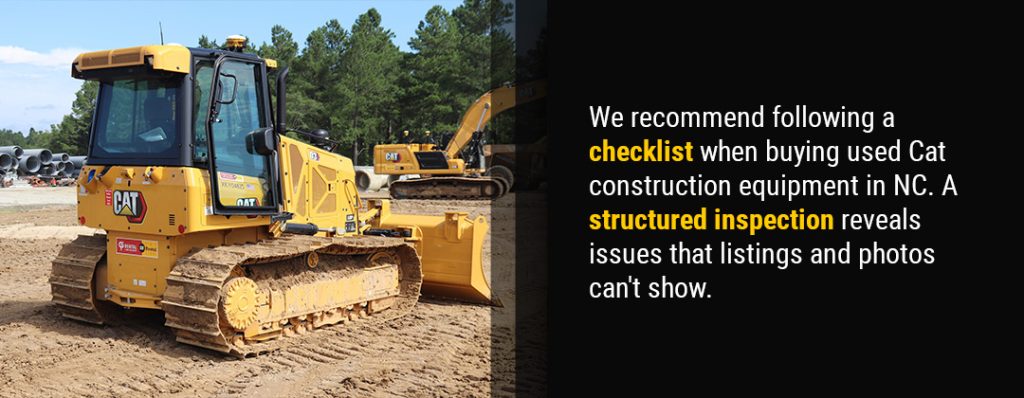
We recommend following a checklist when buying used Cat construction equipment in NC. A structured inspection reveals issues that listings and photos can’t show, so work through each item in sequence to judge past use and future reliability.
A walk-around inspection helps identify signs of past stress that affect long-term structural integrity. This step forms the foundation of any reliable used Cat equipment inspection checklist because visible damage may signal deeper issues.
The undercarriage absorbs constant wear and represents one of the highest ownership costs on tracked equipment. North Carolina’s abrasive soil conditions can accelerate deterioration, especially if the previous owner missed maintenance intervals.
Hydraulic performance affects productivity and safety. Wear in this system may not be immediately apparent, but often worsens quickly once a machine returns to full-duty operation.
Engine conditions influence reliability more than any single component. Sound, pressure and response under load provide early clues about internal wear before warning indicators appear.
Cab systems support operator safety, compliance and daily efficiency. Electrical or control issues often reflect inconsistent maintenance or prolonged exposure to harsh conditions.
Base your decisions on application demands, documentation quality and long-term operating considerations rather than appearance or price alone. The following guidelines for buying used Cat construction equipment in NC focus on protecting reliability and minimizing downtime. They also prevent delays tied to parts access and compliance requirements.
Choosing where to buy used Cat equipment affects performance long after the sale. We support customers across Eastern North Carolina with dealer-level inspection, regional coverage and decades of experience.
Shopping for used Cat equipment doesn’t mean accepting uncertainty or reduced dependability. Knowing how to buy Cat equipment in North Carolina starts with evaluating maintenance history, inspecting high-wear components and assessing real-life operating conditions. When they check all the boxes, used machines can deliver outstanding performance on demanding jobsites.
Confidence comes from informed decision-making, not whether a machine is new or preowned. Gregory Poole Equipment Company adds the safeguards that matter when buying used. We back every machine with dealer-level inspections, verified service history and access to parts and support across Eastern NC. We encourage you to evaluate reliability before you purchase for peace of mind.
Browse our current selection of used Cat equipment or contact a representative to discuss your needs and identify a machine that’s ready to perform on your jobsite.