

Los contratistas y los paisajistas necesitan aumentar su rendimiento sin tener que trasladar maquinaria adicional de una obra a otra. Una miniexcavadora proporciona la fuerza hidráulica necesaria, pero es el implemento el que determina el abanico de tareas y la eficiencia del trabajo.
La elección correcta de los accesorios reduce la manipulación manual de materiales en obras con espacio limitado, donde los equipos necesitan movimientos más rápidos y controlados. La reducción de la manipulación disminuye el riesgo de lesiones y ahorra tiempo de trabajo en cada ciclo. Un mayor aprovechamiento de la maquinaria aumenta el rendimiento de la inversión, ya que permite abordar más proyectos sin tener que desplazar las máquinas con tanta frecuencia.
Para saber qué implementos se pueden acoplar a una miniexcavadora, hay que partir del acoplador, no del implemento de movimiento de tierras. Un sistema de acoplamiento adecuado agiliza los cambios y permite queuna sola máquina realice más tareas en las obrascon menos herramientas específicas.
Un acoplador rápido es el mecanismo de conexión entre la miniexcavadora y el implemento de trabajo. Los equipos que cambian de implementos con frecuencia recurren a los acopladores rápidos para reducir la necesidad de retirar manualmente los pasadores y dedicar el tiempo de funcionamiento de la máquina exclusivamente al trabajo productivo.
Los cambios manuales de pasadores obligan a los operarios a salir de la cabina cada vez que desean cambiar una herramienta. Un acoplador rápido permite al operario soltar una herramienta y coger otra desde el interior de la cabina, lo que supone un ahorro de tiempo.
Los acopladores modernos, como los acopladoresCat®Dual-Lock Pin Grabber, utilizan un diseño en cuña para mantener un ajuste firme durante el funcionamiento. Un mecanismo de bloqueo visible añade una medida de seguridad adicional antes de comenzar el trabajo.
El sistema Cat Tilt Rotate es una interfaz avanzada para los operadores que trabajan en espacios reducidos. Los puntos de acceso estrechos limitan el giro de la pluma y el movimiento de las orugas, lo que amplía las posibilidades de posicionamiento de los implementos más allá de la configuración de una sola máquina en obras con poco espacio.
El sistema permite una rotación continua de 360 grados y una inclinación lateral de hasta 40 grados en el implemento. Este movimiento permite al operario trazar zanjas, trabajar alrededor de postes y esquivar rocas sin necesidad de reajustar la máquina repetidamente.
Un menor número de movimientos de reposicionamiento reduce los desplazamientos innecesarios y permite acortar el tiempo de ciclo. El modelo TRS4 es compatible con máquinas de 2 a 4 toneladas, el TRS6 con modelos de 5 a 6 toneladas y el TRS8 con excavadoras de 7 a 10 toneladas.
Tareas como excavar, abrir zanjas, nivelar y rellenar son trabajos cotidianos de las miniexcavadoras que se simplifican conla elección de la cuchara adecuada. El uso de una cuchara inadecuada obligará a la máquina a esforzarse más, lo que supone un desperdicio de combustible y ralentiza la producción.
Una cuchara zanjadora esuna cuchara estrecha y dentadaque se utiliza para cortar tierra compactada con mayor control. Los fontaneros, los trabajadores de servicios públicos y los contratistas generales utilizan las cucharas zanjadoras para tender tuberías y construir cimientos.
Dado que el cuerpo estrecho limita la anchura de la zanja, la máquina retira menos material en cada pasada. Los dientes concentran la fuerza en pequeños puntos de contacto, lo que permite que la cuchara penetre en terrenos compactos de forma más eficaz que un borde plano.
El perfil más profundo de la cuchara retiene los escombros durante la elevación sin ensanchar el corte, lo que favorece unas paredes de zanja más rectas y un mejor control de la profundidad en materiales compactados.
Una cuchara niveladora es una cuchara ancha, poco profunda y sin dientes, diseñada para mover material suelto, no para excavar. Su borde más ancho permite mover más material en cada pasada, mientras que su forma poco profunda ofrece al operario un mayor control durante el relleno y el alisado de la superficie. Un borde liso deja un acabado más limpio que una cuchara con dientes.
Los paisajistas y los equipos de mantenimiento de carreteras utilizan estas cucharas para los trabajos de acabado. Las cucharas basculantes para limpieza de zanjas de Cat incorporan un sistema de inclinación hidráulica, lo que permite al operador perfilar taludes y pendientes sin tener que cambiar constantemente la posición de la máquina. Las anchuras oscilan entre los 1.000 mm y los 1.200 mm para excavadoras de 1 a 4 toneladas.
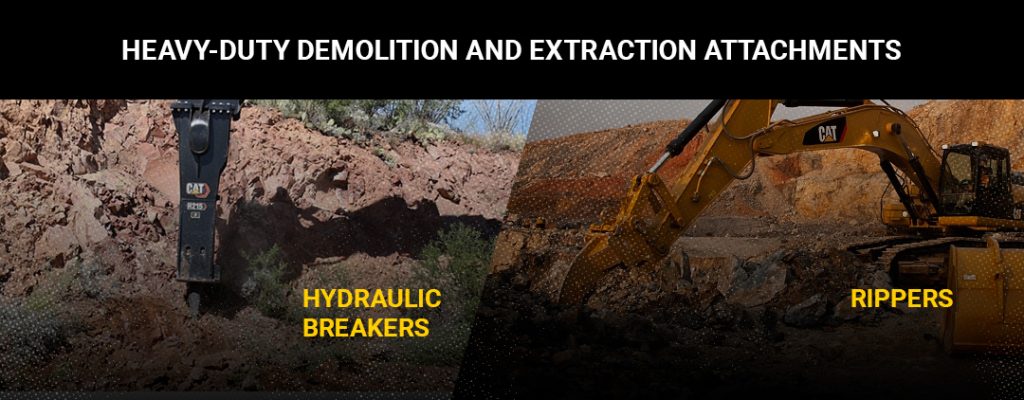
Las cucharas no sirven para trabajar con roca, hormigón ni asfalto. En cambio, los implementos para miniexcavadoras destinados a la construcción incluyen herramientas de demolición y extracción que convierten el caudal hidráulico en una fuerza de rotura concentrada para fracturar y separar superficies duras.
Un martillo hidráulico es un martillo de percusión que utiliza un flujo de aceite a presión para asestar golpes repetidos sobre materiales duros. La acción interna del martillo concentra una gran fuerza en una pequeña superficie de contacto, por lo que la herramienta puede romper materiales que una cuchara no puede atravesar.
Los martillos de la serie Cat B son adecuados para cargas de trabajo más ligeras y ocasionales, destinados a equipos que necesitan una opción más rentable.Los martillos de la serie Cat H están diseñados para el trabajo continuoe incluyen una función de apagado automático para evitar disparos en vacío.
Los equipos de demolición y los trabajadores municipales utilizan martillos hidráulicos para trabajar en aceras, entradas de garaje, cimientos y la retirada de rocas.
Un ripper es una reja de alta resistencia con vástago puntiagudo, diseñada para penetrar en suelos duros y desmenuzar el material. Una vez que el vástago reforzado rompe la superficie, se desliza a lo largo del corte y afloja las capas compactadas, en lugar de levantar y transportar la tierra.
Las empresas de desbroce y los contratistas que trabajan en climas gélidos utilizan rippers cuando las condiciones del terreno no permiten la excavación convencional. Un ripper funciona mejor en suelo helado, arcilla compactada y sistemas radiculares resistentes, ya que facilita la penetración de la cuchara excavadora.
Una cuchara estándar tiene dificultades para manipular objetos como troncos o hormigón troceado, que pueden desplazarse durante la recogida. Los implementos para la manipulación de materiales ofrecen al operador una forma más segura y precisa de agarrar, mover y colocar cargas irregulares.
Una pinza hidráulica es una abrazadera articulada que se monta junto a la cuchara y se ajusta contra la carcasa de esta para sujetar objetos de formas irregulares. Los contratistas utilizan estos accesorios para una amplia variedad de tareas diarias de manipulación.
El diseño convierte la cuchara y la pinza en un dispositivo de sujeción controlado. El operador controla la fuerza de sujeción desde la cabina, de modo que la pinza puede sujetar el material con firmeza sin aplastarlo ni dejarlo caer.
Las pinzas Cat Utility Thumbs son compatibles con una amplia gama de máquinas, cucharas y acopladores, mientras que las pinzas hidráulicas de la serie Pro son ideales para trabajos de demolición y manipulaciones más pesadas.
Una pinza es un accesorio especial diseñado para agarrar material sin necesidad de utilizar una cuchara. Sus mordazas curvas se abren y se cierran alrededor de cargas voluminosas, lo que permite al operador controlar directamente la recogida, la elevación y la suelta.
La forma de las mordazas y la fuerza de sujeción permiten que la pinza sujete material que, de otro modo, se deslizaría o rodaría en una cuchara. Los operarios pueden clasificar escombros mezclados, separar chatarra o colocar piezas más grandes con mayor control.
Los centros de reciclaje,los trabajadores forestales que retiran escombrosy los equipos de limpieza tras demoliciones utilizan pinzas para trabajos que requieren un agarre y un desplazamiento seguros.
Las miniexcavadoras pueden realizar tareas especializadas que van más allá de la excavación habitual, gracias a los implementos diseñados para tareas específicas. Cada implemento desempeña una función concreta para mejorar la velocidad, la precisión y la uniformidad en el terreno.
Unabarrena es una perforadora hidráulicadiseñada para realizar perforaciones profundas y estrechas de forma más rápida y uniforme que la excavación manual. La unidad de accionamiento utiliza el primer circuito hidráulico auxiliar para hacer girar un eje vertical, y la broca penetra en el suelo por la punta.
Las hélices en espiral transportan la tierra hacia arriba a medida que el agujero se hace más profundo, lo que ayuda al operario a mantener una geometría más limpia del agujero. Cat diseña sus barrenas con una relación velocidad-par que equilibra la velocidad de perforación con la fuerza de giro ante diferentes niveles de resistencia del suelo.
Los instaladores de vallas,los trabajadores agrícolas y los paisajistas utilizan barrenaspara realizar perforaciones en lugares predeterminados. El modelo A11 es compatible con máquinas de 1 tonelada, el A23 con excavadoras de 2 toneladas, el A41 con máquinas de 3 toneladas y el A68 con excavadoras de 5 toneladas o más. Todos los modelos se acoplan mediante una interfaz de fijación con pasador.
Los equipos de servicios públicos y las empresas de cimentación utilizan compactadoras de placa cuando necesitan garantizar la estabilidad del terreno.
Un compactador de placa vibratoria es un accesorio planodiseñado para la compactación de superficies. El flujo hidráulico transmite una vibración rápida a través de la placa, que a su vez la transfiere al material de base suelto a lo largo de una amplia superficie de contacto.
El accesorio compacta desde arriba, sin penetrar en la zanja ni levantarla. La oscilación repetida compacta la capa antes de que comience el siguiente paso.
Los modelos Cat CVP16 a CVP55 funcionan con el primer sistema hidráulico auxiliar a través del soporte de la interfaz de herramientas.
Cuando se dispone de las herramientas adecuadas, se puede trabajar de forma más productiva y precisa. Los mejores implementos para una miniexcavadora dependen del trabajo que se vaya a realizar. Nuestra amplia gama de maquinaria Cat ofrece un implemento para cada necesidad, con un rendimiento fiable que mejora la productividad y la eficiencia.
Gregory Poole lleva más de 70 años siendo un proveedor de confianza de maquinaria Cat, prestando servicio a las comunidades del este de Carolina del Norte. Nuestro experimentado equipo puede asesorarte para que elijas los implementos adecuados para tu proyecto, lo que aumentará el tiempo productivo de tu equipo y reducirá los cambios de maquinaria en la obra.
Echa un vistazo a nuestracolección de implementos Catyponte en contacto con nosotroscuando estés listo para hablar sobre la incorporación de un nuevo implemento a tu maquinaria.