

Comprender los componentes de las excavadoras y sus funciones es fundamental para garantizar la eficiencia operativa de estas máquinas complejas. Aunque los diseños y aplicaciones específicos de las excavadoras pueden dar lugar a variaciones en su aspecto y a características especializadas, su estructura básica y sus piezas principales siguen siendo las mismas.
Los siguientes 10 componentes fundamentales funcionan conjuntamente para permitir que la excavadora realice de forma eficiente tareas como excavar, levantar y manipular materiales. Esta guía ofrece una visión general de estas piezas esenciales, detallando sus funciones y cómo contribuyen al rendimiento general de la máquina.
La cabina actúa como centro de mando del operador. Está diseñada para ofrecer una visibilidad óptima y una percepción clara de la situación. En este espacio, los sistemas de control clave suelen incluir:
Las cabinas modernas también sediseñan pensando en la comodidad, lo que ayuda a los conductores a mantenerse concentrados durante las largas jornadas de trabajo.
Los motores de las excavadoras son principalmente diésel y están diseñados para ofrecer un rendimiento constante en entornos exigentes. El motor acciona la bomba hidráulica, que a su vez permite el movimiento y la capacidad de elevación de la excavadora.
Suministra energía a los sistemas eléctricos, lo que garantiza el funcionamiento continuo de elementos como:
El contrapeso se encuentra en la parte trasera de la excavadora y ayuda a mantener el equilibrio de la máquina. Proporciona una estabilidad esencial al contrarrestar el peso de la pluma, el brazo y la cuchara cuando están extendidos. El contrapeso también ayuda a evitar que la máquina se vuelque, ya que mantiene la excavadora firmemente apoyada en el suelo durante el funcionamiento.
El mecanismo de giro permite que la excavadora gire 360 grados. Esta característica es importante para colocar la cuchara con precisión sin tener que cambiar la posición de las orugas. Esto significa que el operador puede girar fácilmente la excavadora para llegar a diferentes lugares, lo que puede ayudar a mejorar la productividad.
El tren de rodaje proporciona soporte estructural a toda la máquina. Está compuesto por varios componentes clave, entre los que se incluye una base estructural, que soporta el peso de la máquina y absorbe los impactos en terrenos irregulares. Los componentes de transmisión actúan conjuntamente con las orugas para hacer avanzar y retroceder a la excavadora. Dado que está siempre en contacto con la superficie de trabajo, el tren de rodaje suele ser la parte que sufre un mayor desgaste, por lo que es importanterealizar un mantenimiento periódico del mismo.
Las orugas permiten que la excavadora se desplace y se mantenga estable en terrenos irregulares. Están diseñadas para hacer frente a las condiciones más exigentes de las obras.
Las orugas reparten el peso de la excavadora sobre una superficie mayor, lo que ayuda a evitar que se hunda en terrenos blandos. Además, proporcionan tracción y estabilidad al agarrarse a superficies irregulares o sueltas, lo que ayuda a que la excavadora se mantenga estable durante su funcionamiento.
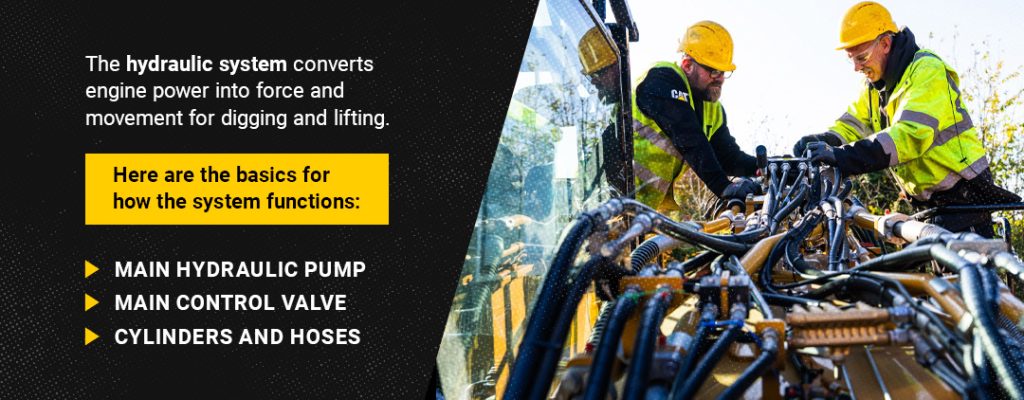
El sistema hidráulico aprovecha la potencia del motor y la transforma en el movimiento y la fuerza necesarios para realizar el trabajo.
Este sistema controla prácticamentetodos los movimientos que realiza la excavadora y es fundamental para la eficiencia de la máquina, sobre todo a la hora de excavar y levantar cargas. A continuación se explican los aspectos básicos del funcionamiento del sistema:
La pluma es un componente esencial de una excavadora. La parte principal, de gran tamaño, se extiende hacia fuera desde el chasis. Proporciona a la excavadora su alcance, lo que permite al operador colocar el brazo y la cuchara para excavar, levantar o colocar materiales.
Las plumas están disponibles en diversas longitudes y configuraciones, dependiendo del uso previsto de la excavadora. Las plumas largas se utilizan generalmente para tareas que requieren un mayor alcance, mientras que las más cortas pueden ser ideales para espacios reducidos.
El brazo, o brazo de la pala, conecta la pluma con el cazo. Es fundamental para controlar el alcance hacia delante de la excavadora, lo que permite al operario excavar o maniobrar con materiales situados a mayor distancia de la máquina.
Además de ampliar el alcance, la palanca también ayuda a controlar el ángulo de excavación, lo que facilita colocar la cuchara con precisión para distintos trabajos.
La cuchara es la pieza que maneja directamente materiales como la tierra y la grava. Está diseñada para realizar diversas tareas, como excavar, recoger y mover.
Las cucharas para excavadoras se presentan en diferentes diseños, y se eligen tipos específicos en función del trabajo que se vaya a realizar. Por ejemplo, se utilizan cucharas especializadas para la excavación de zanjas o para trabajos de excavación pesada.
Una vez que comprendas cada pieza, el siguiente paso es ver cómo funcionan conjuntamente durante una tarea habitual en la obra. La eficiencia de la excavadora se debe a la acción coordinada de estos componentes.
A continuación se muestra un ejemplo sencillo de un ciclo de excavación:
Comprender los componentes de una excavadora va más allá de aprender sus nombres. Conocer las piezas te ayuda de las siguientes maneras:
Los datos sobre seguridad delInstituto Nacional de Seguridad y Salud en el Trabajo(NIOSH) muestran que muchas lesiones en la construcción están relacionadas con la maquinaria en movimiento. Comprender cómo funciona una excavadora y cómo interactúa con su entorno ayuda a mitigar estos riesgos.
Un conocimiento profundo de las piezas esenciales,un servicio profesional y un mantenimiento esmeradoson fundamentales para garantizar que los equipos funcionen de forma segura y constante a lo largo de su vida útil.
Conocer las partes principales de una excavadora y sus funciones constituye una base fundamental para cualquier profesional. Estos conocimientos te permiten tomar decisiones bien fundamentadas en todos los aspectos de la gestión de la maquinaria, desde su funcionamiento hasta su adquisición y mantenimiento.
A medida que tus necesidades crecen, es importante contar con el apoyo adecuado. Gregory Poole cuenta con más de 70 años de experiencia ayudando a los clientes a elegir la maquinaria adecuada, mantenerla correctamente y garantizar el buen desarrollo de los proyectos. Puedes explorar nuestragamacompletade excavadorasCat®o encontrarrecambios originalespara que tu maquinaria siga funcionando como es debido.
Ponte en contacto con nosotros hoy mismoy obtén la asistencia que necesitas para que tu equipo siga funcionando a pleno rendimiento.